
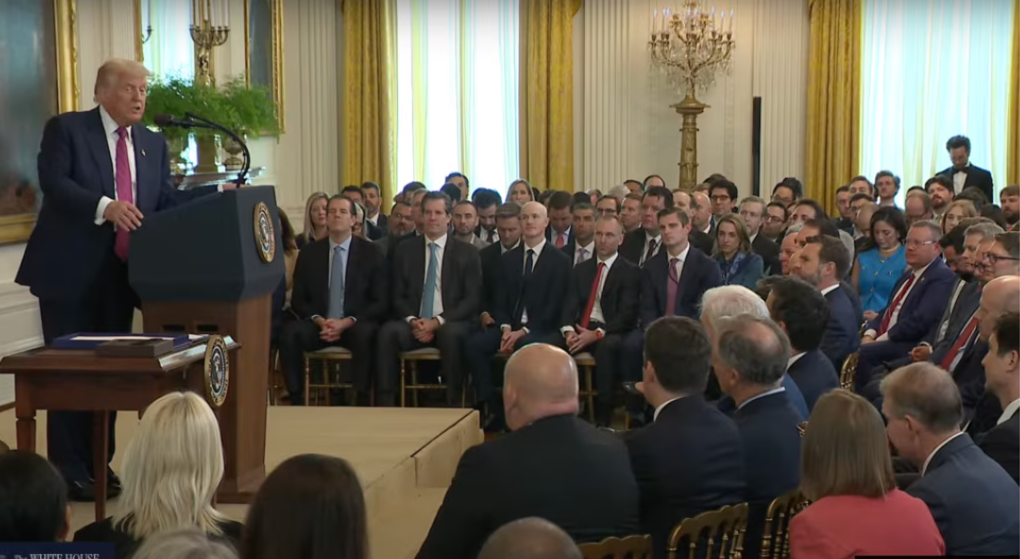
On July 18, 2025, US President Donald Trump signed the Guiding and Establishing National Innovation for U.S. Stablecoins Act into law.
US President Donald Trump signed the first major bill regulating cryptocurrencies into law. Cryptocurrencies are digital currencies that allow people to make direct payments to each other through online systems.
Trump signed the Act, titled the Guiding and Establishing National Innovation for U.S. Stablecoins Act, at a ceremony held at the White House on Friday. Republican lawmakers who supported the bill and executives from the crypto industry attended the signing ceremony.
Before signing, Trump told attendees at the ceremony, “This afternoon, we took a significant step in consolidating America’s dominance in global finance and cryptotechnology.”
He added, “The Guiding and Establishing National Innovation for U.S. Stablecoins Act establishes a clear and concise regulatory framework to identify and unlock the enormous potential of dollar-backed stablecoins. This could be the greatest transformation in fintech since the birth of the internet.”
Stablecoins are a type of cryptocurrency whose value is designed to be stable, unlike other cryptocurrencies such as Bitcoin, whose prices can fluctuate dramatically. Dollar-backed stablecoins, also known as digital dollars, are pegged to the US dollar, meaning that each unit of a dollar-backed stablecoin is always worth $1.
David Sacks, the White House Director for Artificial Intelligence and Cryptocurrency Affairs, spoke at the ceremony. He stated, “For every digital dollar in a cryptocurrency user’s digital wallet, the issuer holds one dollar of traditional dollar reserves in a U.S. bank account, allowing stablecoins to be exchanged for cash.”
Sachs said the “Guiding and Establishing a National Innovation Act for Stablecoins” will “extend the dollar’s dominance” as the international standard currency of payments by creating a “digital dollar” that people around the world can use.
Electronic transactions involving traditional dollars, or “digital cash,” are typically processed by banks and financial platforms like PayPal or Venmo. These platforms are limited by local regulations and system operating hours, which can result in slow and costly cross-border remittances.
Digital dollar transactions allow stablecoins to be sent to cryptocurrency users around the world at any time, bypassing the barriers of traditional financial infrastructure. Transaction information is stored on a blockchain, a digital public ledger or record book operated by a decentralized international network of computers.
Trump stated, “Many Americans don’t realize that behind the scenes, the technological backbone of the financial system is decades behind.”
“The Guiding and Establishing a National Innovation Act for Stablecoins provides a framework for banks, businesses, and financial institutions to issue crypto assets that are backed one-to-one by real dollars, Treasury bills, and other cash equivalents.” “This has indeed strengthened the dollar and given it a prominent position,” he said.
Faced with efforts by the BRICS nations, founded by five major emerging economies, to replace the dollar, Trump vowed to maintain its status as the primary currency for international trade. The five founding members of BRICS are Brazil, Russia, India, China, and South Africa.