
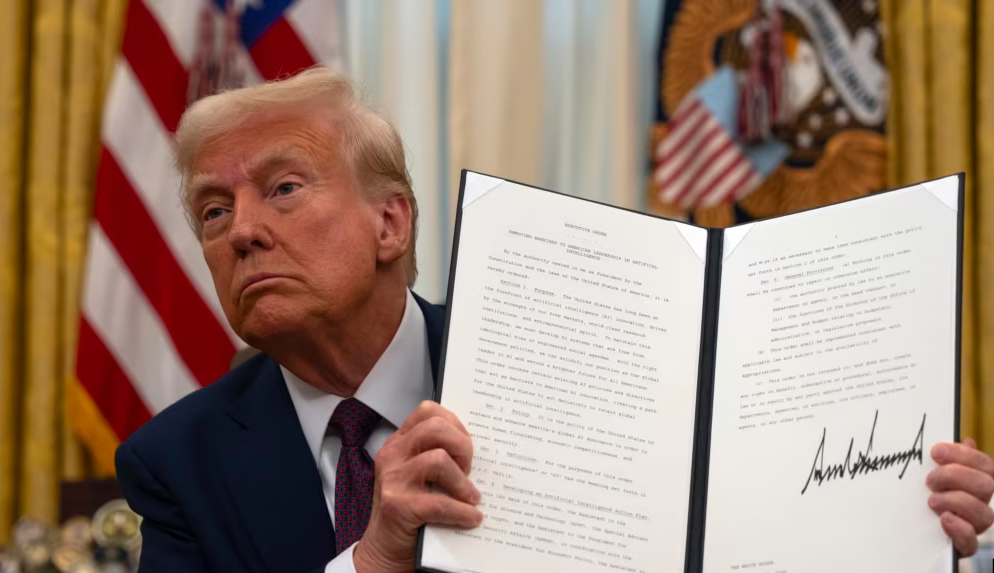
This executive order establishes an 180-day deadline to develop an “Artificial Intelligence Action Plan,” which will formulate policies to “maintain and strengthen America’s global leadership in artificial intelligence to advance human prosperity, economic competitiveness, and national security.”
Trump also instructed his AI advisors and National Security Advisor to work toward overturning the policies and regulations established by former President Joe Biden.
On Monday, President Trump revoked a 2023 executive order signed by President Biden, which sought to mitigate risks posed by artificial intelligence to consumers, workers, and national security.
Biden’s executive order requires developers of artificial intelligence systems that pose risks to U.S. national security, economy, public health, or safety to share security test results with the government under the Defense Production Act before releasing them to the public.
Trump also signed an executive order to establish a cryptocurrency task force, tasked with developing a new regulatory framework for digital assets and exploring the creation of a cryptocurrency reserve.
The highly anticipated action also mandated the protection of banking services for cryptocurrency companies and prohibited the creation of central bank digital currencies that could compete with existing cryptocurrencies.
The executive order demonstrates Trump’s fulfillment of his campaign pledge to become the’ president of cryptocurrencies’ and advance the adoption of digital assets.
This stands in stark contrast to President Biden’s regulators, who have been cracking down on cryptocurrency firms to protect Americans from fraud and money laundering, and have filed lawsuits in federal courts against dozens of exchanges including Coinbase, Binance, and Kraken.
The task force will comprise the U.S. Secretary of the Treasury, Attorney General, Chairmen of the SEC and CFTC, and other heads of relevant agencies. Its mandate is to establish a regulatory framework for digital assets, including stablecoins—cryptocurrencies typically pegged to the U.S. dollar.
The panel will also assess the feasibility of establishing and maintaining a national digital asset reserve, which could be funded by cryptocurrencies lawfully seized by the federal government through enforcement actions.
Last December, Trump appointed David Sacks, a venture capitalist and former PayPal executive, as the ‘Czar’ of cryptocurrency and artificial intelligence. The executive order stated that he would chair this task force.